

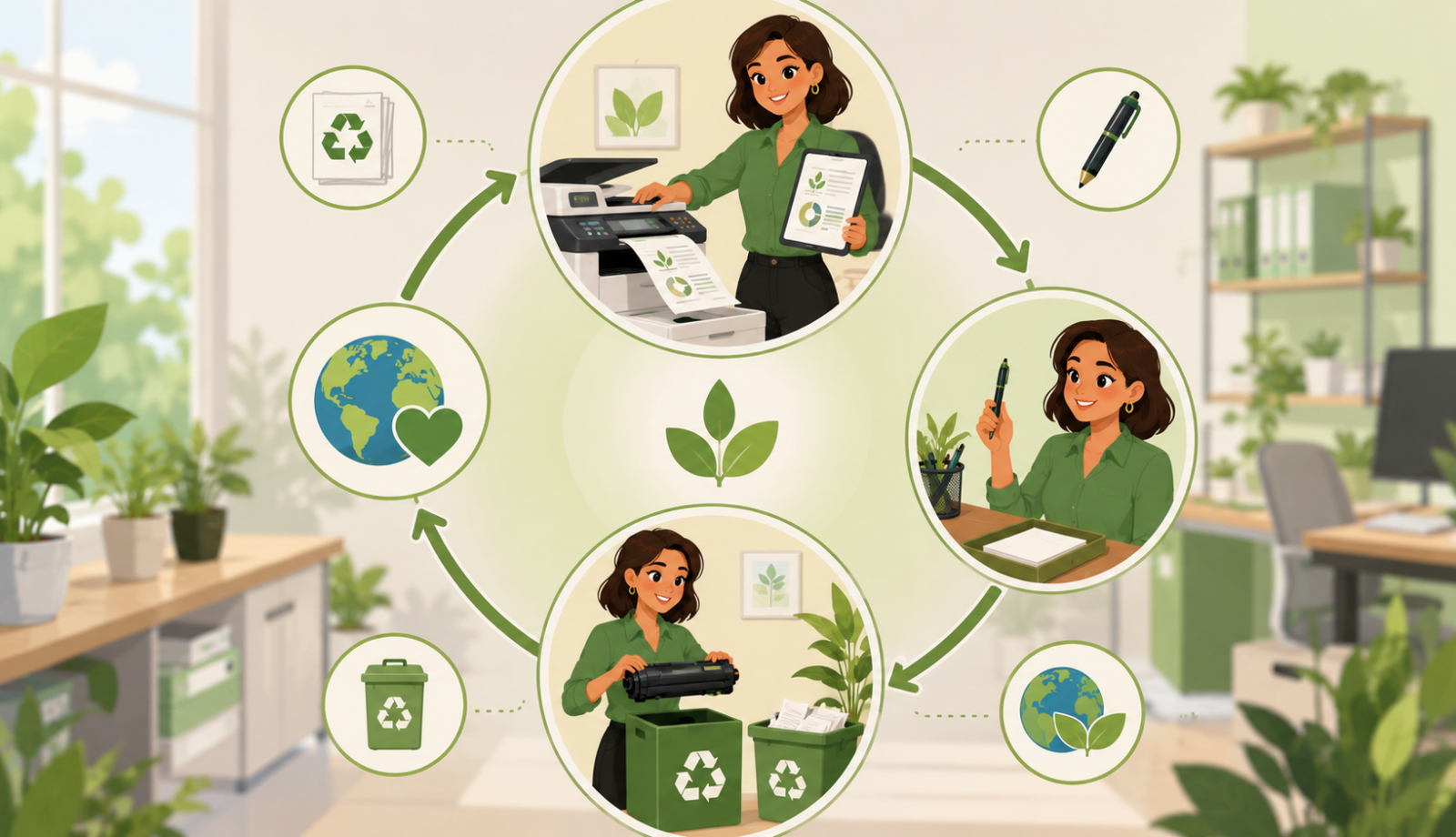
A practical guide, because small changes add up to a big difference
When you think about sustainability, what comes to mind? Recycling bins? Electric vehicles? Solar panels?
Probably not your office stationery cupboard.
But here’s the thing: the average office goes through an enormous amount of supplies. Paper. Pens. Toner. Envelopes. Sticky notes. Cleaning products. And most of it ends up in landfill, often unnecessarily.
The good news? Creating a sustainable office supply routine doesn’t require a complete overhaul. It doesn’t have to be expensive. And it doesn’t need a dedicated sustainability officer.
Small, consistent changes add up. Less paper waste. Fewer single-use plastics. Refillable instead of disposable. Recycle what you can’t reduce.
In this article, I’ll walk you through practical, affordable ways to create a sustainable office supply routine. No guilt trips. No unrealistic demands. Just honest, actionable steps that save money and reduce environmental impact.
Let’s dive in.
Part One: Why Sustainability Matters for Your Business
Before we get into the how, let’s talk about the why.
The business case for sustainable supplies:
| Benefit | What it means |
| Lower costs | Less waste means buying less. Sustainable choices often save money. |
| Employee satisfaction | Your team cares about the environment. They want to work for a responsible business. |
| Client preference | Many clients prefer to work with sustainable suppliers. It’s a competitive advantage. |
| Regulatory readiness | Environmental regulations are increasing. Getting ahead now saves headaches later. |
| Brand reputation | Sustainability is visible. It tells a story about your values. |
The environmental reality:
- A single ream of paper uses one tree’s worth of wood pulp
- The average office worker uses 10,000 sheets of paper per year
- Most pens are not recyclable and take centuries to decompose
- Toner cartridges can take 1,000+ years to break down in landfill
The good news? Most of this waste is completely avoidable. Small changes in what you buy and how you use it make a real difference.
Part Two: The Sustainable Supply Hierarchy
Think of sustainability as a hierarchy. Reduce first. Then reuse. Then recycle. Then dispose responsibly.
The hierarchy:
- Reduce → Use less. Print double-sided. Go digital where possible.
- Reuse → Refillable pens. Reusable envelopes.
- Recycle → Recycle paper, toner cartridges, batteries, electronics.
- Responsible disposal → What can’t be recycled or reused goes to proper disposal.
Why this order matters:
Reducing is better than reusing. Reusing is better than recycling. Recycling is better than landfill. Start at the top and work down.
Part Three: Sustainable Sourcing (What to Buy)
The first step is choosing better products.
Paper Products
Paper is the largest supply category for most offices. Small changes here make a big difference.
What to look for:
| Feature | Why it matters |
| Recycled content | Look for 100% post-consumer waste recycled paper |
| FSC certified | Ensures paper comes from responsibly managed forests |
| Chlorine-free | Bleaching process is less harmful to the environment |
| Recyclable packaging | Some paper comes in plastic wrap; look for paper-wrapped reams |
Our recommendation: Start with 50-100% recycled content paper for internal documents. Use virgin paper only for client-facing materials where quality matters most. The price difference is often minimal (£0.50-1 per ream).
What to avoid: Paper with no recycled content. Paper wrapped in non-recyclable plastic. Bleached paper without certification.
Writing Instruments
Pens are a huge source of office waste. And most are not recyclable.
Better options:
- Refillable pens → Keep the barrel, replace the ink. Less plastic waste.
- Pens made from recycled materials → Many brands now offer pens made from recycled plastic or biodegradable materials.
- Pencils → Renewable resource, biodegradable.
- Digital alternatives → Do you really need to write it down? Could you type it instead?
Our recommendation: Switch to refillable pens for shared supply cupboards. For personal pens, provide a collection box for empties (some brands have recycling programmes).
What to avoid: Single-use, non-refillable pens. Promotional pens that will be used once and thrown away.
Toner and Ink Cartridges
Toner waste is a significant environmental problem. But there are better ways.
What to look for:
- Remanufactured cartridges → Used cartridges cleaned, refilled, and tested. Often cheaper than new.
- Suppliers with take-back programmes → Some manufacturers will recycle your empty cartridges for free.
- High-yield cartridges → Fewer cartridges, less packaging, lower cost per page.
Our recommendation: Use remanufactured cartridges from a reputable supplier. Set up a collection box for empties and send them back for recycling.
What to avoid: Throwing cartridges in general waste. Most are recyclable.
Envelopes and Packaging
Envelopes are often used once and thrown away.
Better options:
- Reusable envelopes → Two compartments, can be used twice
- Windowless envelopes → Easier to recycle (windows are often not recyclable)
- Padded envelopes from recycled materials → Available from most suppliers
- Digital alternatives → Do you need to post it? Could you email or use a portal?
Our recommendation: Keep a tray of “used but usable” envelopes for internal mail. Buy envelopes made from recycled content.
What to avoid: Plastic padded envelopes (hard to recycle). Envelopes with plastic windows (unless you remove them before recycling).
Cleaning Supplies
Offices go through a surprising amount of cleaning products.
Better options:
- Concentrated products → Less packaging, less transport weight
- Refillable bottles → Keep the spray bottle, buy refills
- Biodegradable, non-toxic formulas → Better for staff and environment
- Microfibre cloths → Reusable, long-lasting, reduce paper towel waste
Our recommendation: Switch to concentrated, refillable cleaning products. Provide reusable microfibre cloths instead of paper towels.
What to avoid: Single-use cleaning wipes (they contain plastic and aren’t recyclable). Aerosols (harmful propellants).
Binders, Folders, and Filing Supplies
These items are often made from virgin plastic and used for a short time.
Better options:
- Recycled cardboard folders → Biodegradable, recyclable
- Binders made from recycled materials → Available from most suppliers
- Digital filing → The most sustainable folder is the one you don’t buy
Our recommendation: Before buying new filing supplies, purge old ones. Can you reuse existing folders? Can you file digitally instead?
What to avoid: Plastic sheet protectors (use sparingly). Brand new binders when reused ones would work.
Part Four: Sustainable Usage Habits (How to Use)
Buying sustainable products is important. But using them sustainably matters more.
Paper Reduction Habits
Simple changes that add up:
- Set double-sided as default → Cuts paper use in half overnight
- Print multiple pages per sheet → 2-up or 4-up for internal drafts
- Use digital proofing → Review documents on screen, not on paper
- Create a scrap paper tray → Single-sided misprints become notepaper
- Go paperless where possible → Invoices, reports, memos, feedback forms
Pro tip: Run a “paper reduction challenge” for a month. Track your usage before and after. Celebrate the savings.
Toner and Ink Reduction Habits
Simple changes that add up:
- Use draft/eco mode for internal documents → Uses 30-50% less toner
- Print in black and white unless colour is essential → Colour toner is more expensive and less environmentally friendly
- Only replace toner when the printer stops → “Low toner” warnings often appear with hundreds of pages left
- Shake cartridges gently when low → Extends life by hundreds of pages
Pro tip: Set draft mode and black and white as your printer defaults. Make colour and high quality manual overrides.
Writing Instrument Habits
Simple changes that add up:
- Provide refillable pens in shared areas → One barrel, many refills
- Collect empty pens for recycling → Some brands offer recycling programmes
- Use digital notes instead of sticky notes → OneNote, Evernote, or even a simple text file
- Think before you print an email → Do you really need a hard copy?
General Supply Habits
Simple changes that add up:
- Take stock before ordering → Check what you already have
- Share supplies → One stapler for a team, not one per desk
- Repair rather than replace → Can that stapler be fixed? Those scissors sharpened?
- Donate unused supplies → Schools, charities, and community groups welcome donations
Part Five: Recycling and Disposal (What to Do with Waste)
Even with the best habits, you’ll still have waste. Here’s how to handle it responsibly.
Paper and Cardboard
Recycle: Clean, dry paper and cardboard. Most offices already do this.
Don’t recycle: Soiled paper (food-stained, wet). Shredded paper (check with your recycler, some accept it, some don’t). Thermal paper (receipts, not recyclable).
Toner and Ink Cartridges
Recycle: Some manufacturers offer free take-back programmes. Some office supply stores also accept them. Remanufacturers will buy certain cartridges.
How to set it up: Place a collection box next to the printer. When it’s full, use the pre-paid shipping label (most programmes provide one) and send them back.
Don’t recycle: Throw them in general waste. They take centuries to break down.
Pens and Markers
Recycle: Some brands offer recycling programmes (e.g., Bic, Pilot, Sharpie). Terracycle offers zero-waste boxes for pens and markers (paid service).
Better: Switch to refillable pens. Much less waste.
Don’t recycle: Throw them in general waste. Most curbside recycling doesn’t accept pens.
Batteries
Recycle: Most office supply stores and hardware stores have battery recycling boxes. Some local authorities offer collection.
Don’t recycle: Throw batteries in general waste. They contain hazardous materials.
Electronics (including old printers, copiers, computers)
Recycle: Certified e-waste recyclers. Many manufacturers offer take-back programmes. Some charities accept working equipment.
Don’t recycle: Throw in general waste. E-waste contains valuable materials that should be recovered, and hazardous materials that shouldn’t go to landfill.
Cleaning Product Bottles
Recycle: Rinse and recycle plastic bottles (check with your local recycler). Better yet, switch to refillable systems.
Don’t recycle: Bottles with hazardous residue (leave empty but don’t rinse toxic products down the drain).
Part Six: Creating Your Sustainable Supply Routine
Now let’s put it all together into a routine you can actually follow.
Weekly (5-10 minutes)
- Check scrap paper tray → Empty into recycling if full
- Check pen collection box → Send empties for recycling
- Check toner collection box → Send empties for recycling
- Top up shared supplies → Refillable pens, scrap paper, etc.
Monthly (15-20 minutes)
- Review paper usage → Are you on track for reduction targets?
- Review toner usage → Any unexpected spikes? (Could indicate waste)
- Check cupboard for expired or damaged items → Dispose responsibly
- Order sustainable alternatives → Replace non-sustainable items as they run out
Quarterly (30 minutes)
- Do a full supply audit → What are you buying? What are you using? What’s being wasted?
- Review recycling setup → Are bins clearly labelled? Is everyone using them?
- Set reduction targets → For next quarter: paper, toner, or other category
- Celebrate wins → Share progress with your team
Annually (1 hour)
- Review all suppliers → Are there more sustainable options available?
- Assess progress → How much have you reduced? Recycled? Saved?
- Set next year’s goals → Ambitious but achievable
- Renew commitments → Sustainability is ongoing
Part Seven: Engaging Your Team
Sustainability is a team sport. You can’t do it alone.
Make It Easy
- Clear, labelled bins for recycling, compost, and landfill
- Collection boxes for pens, toner, batteries near the point of use
- Scrap paper trays next to every printer
- Default settings already sustainable (double-sided, black and white, draft mode)
Make It Visible
- Share progress → “We recycled 50 cartridges this month!”
- Celebrate wins → “Our paper use is down 30% this quarter!”
- Show the impact → “That’s 12 trees saved.”
- Name a sustainability champion → Someone who keeps it on the agenda
Make It Normal
- Include sustainability in new team member orientation
- Talk about it in team meetings (briefly, don’t bore people)
- Ask for ideas → Your team will have suggestions you haven’t thought of
- Lead by example → If you use sustainable supplies, others will too
Part Eight: Real Examples (Location-Neutral)
Here are a few examples of businesses that created sustainable supply routines.
Example 1: The Paper Reduction Challenge
A professional services firm challenged each department to reduce paper use by 25% in three months. They set double-sided as default, created scrap paper trays, and encouraged digital proofing.
The result: Three departments hit the target. Two exceeded it. Overall paper use dropped by 28%. Annual saving: £1,200.
Example 2: The Toner Recycling Programme
A medium-sized business was throwing toner cartridges in general waste. They didn’t know recycling was free and easy.
They set up a collection box next to the copier. They printed the manufacturer’s pre-paid shipping label. When the box was full, they sent it back.
The result: 80 cartridges recycled in the first year. Zero cartridges to landfill. And the programme required almost no staff time.
Example 3: The Refillable Pen Switch
A small office was going through 200 disposable pens per year. They switched to refillable pens for the shared supply cupboard.
The result: 200 disposable pens saved in year one. Annual cost dropped by 60% (refills are cheaper than new pens). Less plastic waste. Happier team (the refillable pens were better quality).
Example 4: The Supplier Switch
A marketing agency reviewed their supply suppliers and found that most offered sustainable alternatives, often at similar prices.
They switched to recycled paper, refillable pens, remanufactured toner, and recycled envelopes.
The result: No increase in supply budget. Significant reduction in environmental impact. And they could now tell clients about their sustainable practices, a competitive advantage.
Part Nine: The One-Page Sustainable Supply Checklist
Use this to assess and improve your office supply routine.
Sourcing (What to Buy)
- Paper has recycled content (50-100% where possible)
- Paper is FSC certified
- Toner is remanufactured or from take-back programme
- Pens are refillable (shared areas)
- Envelopes have recycled content (no plastic windows where possible)
- Cleaning products are concentrated and refillable
Usage Habits (How to Use)
- Double-sided printing is default
- Black and white printing is default
- Draft/eco mode is default
- Scrap paper trays are next to each printer
- Digital proofing is encouraged
- Toner replaced only when printer stops (not at “low” warning)
Recycling and Disposal
- Paper and cardboard recycling bin clearly labelled
- Toner collection box next to printer
- Pen collection box near supply cupboard
- Battery recycling box accessible
- Staff know what goes where
Engagement and Improvement
- Sustainability is discussed in team meetings (occasionally)
- Progress is shared (monthly or quarterly)
- New team members are shown the system
- Reduction targets are set (quarterly or annually)
- A sustainability champion is named (rotating role)
Final Thoughts
Creating a sustainable office supply routine doesn’t require a complete overhaul. It doesn’t have to be expensive. It doesn’t need a dedicated sustainability officer.
Start with one thing.
Switch to double-sided printing as default. That alone cuts paper use in half. Add a toner recycling box. Switch to refillable pens for shared areas. Choose recycled paper next time you order.
Small changes, consistently applied, add up to a big difference. For your budget. For your team. For the planet.
And if you’d like a friendly, no-pressure chat about sustainable office supplies, whether that’s finding better products, setting up recycling, or just honest advice, just reach out.
We’re independent. We’re here to help. And we won’t sell you things you don’t need.