

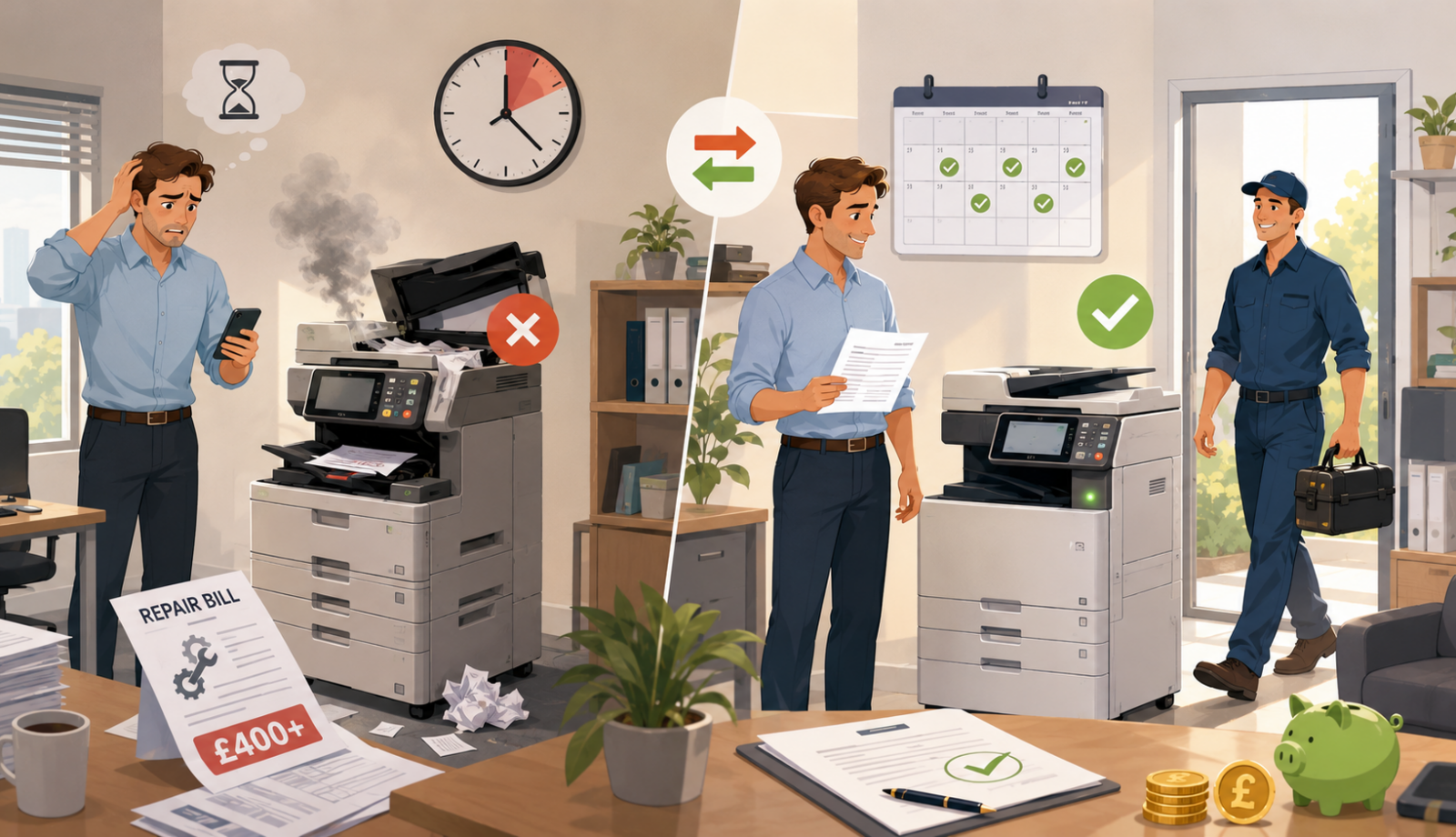
A practical guide, because hoping nothing breaks isn’t a strategy
You bought a copier. It worked. And you thought, “Great, we’re done.”
But here’s the thing about copiers: they’re machines. They have moving parts. They heat up. They cool down. They process thousands if not millions of pages. And eventually, things wear out.
A roller slips. A sensor fails. A fuser stops heating. A paper jam turns into something more serious.
And when that happens, you have two choices: call and pray, or call and know.
A service contract is the difference between hoping nothing breaks and knowing you’re covered when it does.
In this article, I’ll walk you through why your business needs a copier service contract. The costs. The benefits. The peace of mind. And how to choose the right one.
Let’s dive in.
Part One: What Is a Copier Service Contract? (In Plain English)
Let me explain without the jargon.
A copier service contract is simply an agreement with a support provider to keep your copier running. You pay a regular fee (monthly or quarterly). In return, the provider takes care of:
| What’s included | What it means |
| Regular maintenance | Scheduled cleanings and checks to prevent problems |
| Repairs | When something breaks, we fix it |
| Parts | Replacement parts are included (no surprise bills) |
| Labour | You don’t pay for the technician’s time |
| Response time | We agree to come within a certain time (e.g., 4 hours, next day) |
| Often, toner and consumables | Many contracts include toner, drums, and other supplies. Ours do, some don’t. |
In short: You pay a predictable monthly fee. You never get a surprise repair bill. And when something breaks, you make one call and they fix it.
Part Two: The Case for a Service Contract
Why should you consider a contract? Let me give you five compelling reasons.
Reason 1: Predictable Costs
This is the headline benefit. And it’s huge.
Without a contract:
- You pay when something breaks
- You don’t know when that will be
- You don’t know how much it will cost
- A single repair can be £200-500+
- Multiple repairs in a year can cost £1,000+
With a contract:
- You pay a fixed monthly fee (£50-150 per month for most offices)
- You know exactly what you’ll spend each month
- No surprise bills
- Budgeting is simple
Real maths: A business without a contract had three repairs in one year: £250, £180, and £400. Total: £830. A service contract would have cost £600 for the year. They saved £230 AND got peace of mind.
Reason 2: Faster Response Times
When your copier breaks, you need it fixed. Fast.
Without a contract: You’re a one-off customer. You call, you wait, you hope someone shows up. Priority goes to contract customers. You might wait days.
With a contract: You’re a priority customer. The provider has committed to a response time (often 4 hours or next business day). They have a contractual obligation to show up.
Example: A business without a contract called for a repair on a Tuesday. The technician came on Friday. Four days of no copier. A contract customer called on Tuesday. The technician came on Wednesday. One day of no copier.
Reason 3: Preventative Maintenance
This is the benefit you don’t see. And it’s the most valuable.
Without a contract: You only call when something breaks. You’re always reacting. Problems are always emergencies.
With a contract: The provider does regular maintenance. They clean, lubricate, and check components. They spot problems before they become emergencies. They prevent breakdowns.
Example: A business with a contract had a technician visit quarterly. On one visit, the technician noticed a worn roller that was about to fail. They replaced it during the visit. No downtime. No emergency. No cost. Without the contract, that roller would have failed mid-job on a Friday afternoon.
Reason 4: Included Toner and Consumables
Many contracts include toner, drums, and other consumables. This is a massive convenience.
Without a contract: You order toner when you run out. You pay whatever the price is. You wait for delivery. You might run out completely.
With a contract: Toner is included. The provider monitors your usage and sends toner before you run out. You never have to think about it.
Example: A business with a contract never ran out of toner. The provider delivered new cartridges automatically. Without the contract, they were running out once a month and paying full retail.
Reason 5: Peace of Mind
This is the intangible benefit. And it’s real.
Without a contract: You worry. Every time the copier makes a strange noise. Every time it slows down. Every time someone mentions “jams.” You’re always wondering: “Is it going to break? How much will it cost? How long will we be without it?”
With a contract: You don’t worry. If it breaks, you call. They fix it. It’s someone else’s problem.
Example: A business owner said: “The best part of the contract is I don’t think about the copier anymore. I used to worry about it constantly. Now it’s just… there. Working.”
Part Three: What’s the Cost?
Let’s talk about money. Because that’s what matters.
Typical Contract Costs
| Office size | Typical monthly cost | What’s included |
| 1-5 people | £30-60 | Service, parts, labour (not usually toner) |
| 6-15 people | £60-120 | Service, parts, labour, often toner |
| 16-30 people | £100-200 | Service, parts, labour, toner, often consumables |
| 30+ people | £200-400+ | Full service including everything |
What You’re Buying
| Cost component | Without contract | With contract |
| Annual repairs (typical) | £200-800+ | £0 |
| Annual toner costs | £200-600 | £0 (if included) |
| Annual consumables | £100-300 | £0 (if included) |
| Annual energy costs | Same either way | Same either way |
| Total | £500-1,700+ | £360-1,200 |
The Payback
A service contract typically costs less than the repairs and toner you’d buy anyway. For most businesses, the contract pays for itself.
Example: A business spends £400 per year on toner and £300 per year on repairs. Total: £700. A service contract costs £600 per year (including toner and repairs). They save £100 per year AND get peace of mind. Not to mention staff productivity downtime saved.
Part Four: What to Look For in a Contract
Not all contracts are created equal. Here’s what to look for.
Essential Elements
| Element | What to look for | Red flag |
| Response time | 4 hours or next business day | “We’ll get there when we can” |
| Included parts | All parts except consumables (and consumables if possible) | “Parts are extra” |
| Labour | All labour included | “Labour charged at £X per hour” |
| Toner | Included if possible | Not included |
| Preventative maintenance | Scheduled visits (quarterly recommended) | “Call us when something breaks” |
| Contract term | 12 months (or 36 months with good terms) | 5 years with no exit |
Questions to Ask
- “What’s the response time guarantee?”
- “What’s NOT included?” (Get it in writing)
- “How do I get a replacement if the machine is beyond repair?”
- “What happens if I need to cancel early?”
- “Do I have to use genuine toner?”
- “Is there a page limit?” (If so, what’s the overage cost?)
Red Flags
| Red flag | Why it’s a problem |
| Vague response times | You’ll wait. Then wait some more. |
| “Parts extra” | You’ll get surprise bills for every repair. |
| 5-year contract with no exit | You’re locked in. Even if the service is terrible. |
| “We use only genuine parts and charge you” | Expensive. And they profit from repairs. |
| No scheduled maintenance | They only fix things, never prevent them. |
Part Five: Contract vs Pay-As-You-Go
Let me help you decide which is right for you.
Choose a Contract If…
- You have 5+ people using the copier
- The copier is critical to your business
- You hate surprise bills
- You want predictable monthly costs
- You don’t want to think about maintenance
- You want fast response times
Choose Pay-As-You-Go If…
- You have 1-2 people using the copier
- The copier isn’t critical (you could survive without it)
- You have a backup printer
- You’re willing to shop around for repairs
- You have a very tight budget
Pro tip: For most businesses, a contract is the better choice. The peace of mind alone is worth the cost.
Part Six: Examples
Here are a few examples of businesses that benefited from service contracts.
Example 1: The Surprise Repair
A small business had no contract. Their copier broke down. The repair cost £400. They paid it. Three months later, it broke again. Another £350. Total for the year: £750.
The fix: They bought a service contract, including all repairs and toner.
The result: They saved £150 in the first year. They never had a surprise bill. And they got a faster response time.
Example 2: The Toner Hassle
A growing business was ordering toner every few weeks. Different people ordered different cartridges. They ran out regularly. They paid full retail.
The fix: They signed a contract that included toner. The provider monitored usage and delivered toner automatically.
The result: They never ran out. They saved 20% on toner costs. The office manager saved 2 hours per month on supply administration.
Example 3: The Downtime Disaster
A busy office had no contract. Their copier broke on a Monday morning. They called for a repair. The technician came on Wednesday. Two days of no copier. Staff were frustrated. Clients were delayed.
The fix: They signed a contract with a 4-hour response time guarantee.
The result: When the next breakdown happened, a technician arrived within 4 hours. Downtime was minimal. Staff were happier.
Example 4: The Preventative Visit
A business had a contract with quarterly preventative maintenance. During a routine visit, the technician noticed a worn fuser. It was about to fail. They replaced it during the visit.
The result: No downtime. No emergency. No repair bill. The fuser would have failed within weeks, causing a major breakdown and days of downtime.
Part Seven: How to Choose the Right Provider
Not all providers are equal. Here’s how to choose.
Look For:
| Quality | Why it matters |
| Local presence | They can be there fast. You’re not waiting for a national call centre. |
| Good reputation | Check reviews. Ask for references. |
| Transparent pricing | No hidden fees. Clear what’s included and what’s not. |
| Written contract | All terms in writing. No verbal promises. |
| Flexible terms | 12-month contracts are better than 5-year lock-ins. |
Ask For:
- References from similar businesses
- A sample contract (read it before you sign)
- A clear list of what’s included and what’s not
- A response time guarantee (in writing)
Final Thoughts
Your copier is critical to your business. When it works, you don’t think about it. When it breaks, everything stops and problems start backing up.
A service contract gives you: predictable costs, faster response times, preventative maintenance, included toner and consumables, and peace of mind.
You don’t have to worry about surprise repair bills. You don’t have to wonder when the technician will show up. You don’t have to remember to order toner.
You make one call. We fix it. That’s it.
For most businesses, the contract pays for itself in reduced repairs and toner costs. And the peace of mind is priceless.
If you’d like a friendly, no-pressure chat about copier service contracts, whether that’s advice on what to look for, help choosing a provider, or just honest guidance, just reach out.
We’re independent. We’re here to help. And we won’t sell you things you don’t need.