

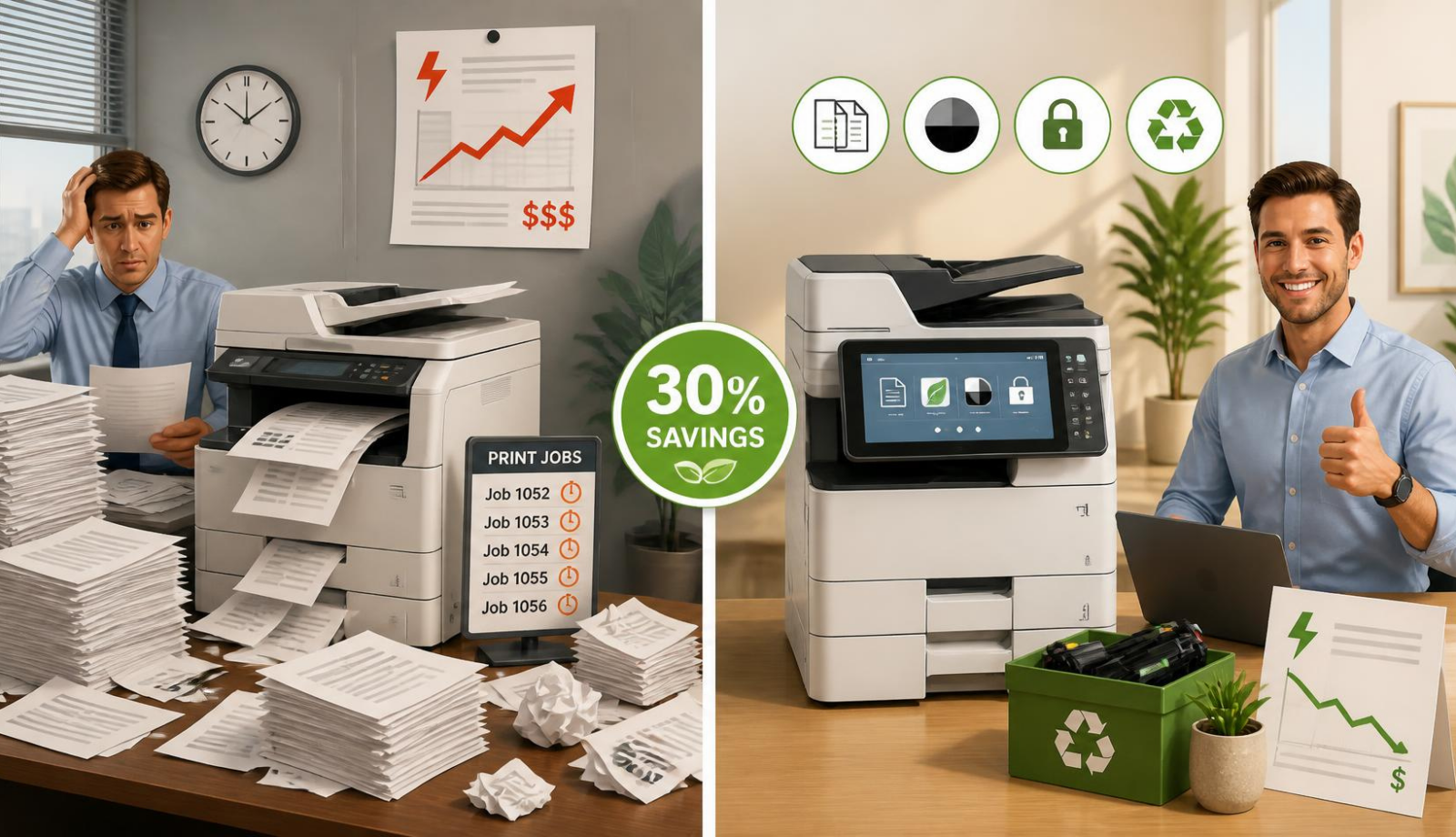
A friendly, practical guide, because going green is good for your budget too
When you think about “eco-friendly printing,” what comes to mind? Tree-hugging idealism? Higher costs? Complicated changes that disrupt your workflow?
The reality is quite different.
Today, businesses are discovering that sustainable printing isn’t just good for the planet, it’s good for their bottom line. The same changes that reduce waste and energy consumption also cut costs. And the companies that are leading the way aren’t just feeling good about themselves. They’re winning business, impressing clients, and building competitive advantage.
In this article, I’ll walk you through how businesses across all sectors are cutting waste and costs through eco-friendly printing. No guilt trips. No unrealistic demands. Just practical, proven strategies that deliver real results.
Let’s dive in.
Part One: Why Sustainability Is Becoming a Business Imperative
Sustainability used to be a “nice to have.” Something you did if you had extra budget and cared about the planet.
That’s changed.
What’s driving the shift:
- Client demand: Large companies increasingly require sustainability credentials from their suppliers. A print management company discovered this firsthand when a client’s first question was “What’s your environmental policy?”,
- Regulatory pressure: New regulations like the EU’s Corporate Sustainability Reporting Directive (CSRD) require greater transparency on resource usage and pollution,
- Cost savings: Sustainable practices reduce waste, energy use, and consumable consumption. Lower costs go straight to your bottom line,
- Competitive advantage: Companies with strong sustainability credentials differentiate themselves from competitors,
The bottom line: Sustainability has moved from “optional” to “essential.” As one industry expert put it, green printing has shifted from a “market differentiator to a business necessity”,
Part Two: The “Reduce” Strategy, Less Printing, Less Waste
The most effective way to reduce your printing footprint is to print less. Sounds obvious, but it’s often overlooked.
Print Smarter, Not More
What it looks like:
- Double-sided (duplex) as default: This single change cuts paper use in half. Most modern printers support it, yet many offices still default to single-sided,
- Black and white as default: Colour toner is 3-5x more expensive and less environmentally friendly. Set black and white as your default, and make colour a deliberate choice,
- Draft or eco mode: For internal documents, draft mode uses 30-50% less toner with no noticeable quality difference,
- Secure print release: Documents only print when the user authenticates at the machine. This eliminates uncollected print jobs, which are a major source of waste,
What you save:
A typical office can reduce paper and toner costs by 20-40% with these simple default changes. For a 20-person office, that could be £500-1,500 per year.
Go Digital First
What it looks like:
- Scan to cloud: Convert paper documents to digital files directly from the printer. Modern multifunction devices (MFPs) make this simple,
- Digital workflows: Paper documents can be scanned, converted to searchable PDFs, and automatically routed to the right folder, no printing required,
- Digital proofing: Review documents on screen, not on paper. This eliminates the “print, mark-up, reprint” cycle.
What you save:
Paper waste makes up nearly half of all business waste. Reducing unnecessary printing is the single biggest win for both sustainability and cost.
Part Three: The “Choose Better” Strategy, Sustainable Sourcing
When you do need to print, choose products and partners that minimise environmental impact.
Paper and Materials
What to look for:
- Recycled content: Paper with 50-100% post-consumer recycled content,
- FSC certification: Ensures paper comes from responsibly managed forests,
- Recyclable packaging: Some paper comes in plastic wrap; look for paper-wrapped reams,
The cost reality: Sustainable paper is often only marginally more expensive than virgin paper, sometimes the same price,
Toner and Consumables
What to look for:
- Remanufactured cartridges: Used cartridges cleaned, refilled, and tested. Often cheaper than new,
- Cartridge take-back programmes: Many manufacturers offer free recycling of empty cartridges,
- High-yield cartridges: Fewer cartridges, less packaging, lower cost per page.
What to avoid: Throwing cartridges in general waste. They take centuries to break down and are often 100% recyclable.
Choose a Sustainable Partner
Your suppliers matter. Look for providers with:
- Responsible lifecycle management: They don’t just sell equipment; they manage it from manufacturing to end-of-life recycling,
- Circular economy practices: Use of recycled materials in manufacturing, take-back programmes, and zero-waste-to-landfill policies,
- Carbon balancing: Some providers offer carbon offsetting for your entire print operation,
Example: A UK print management company discovered that by asking their suppliers about their sustainability practices, they could use their buying power to influence positive change throughout the supply chain,
Part Four: The “Optimise” Strategy, Smart Technology
Modern print technology offers tools that significantly reduce environmental impact.
Energy-Efficient Devices
What to look for:
- ENERGY STAR certified: Devices that use significantly less energy than non-certified models,
- Low Total Energy Consumption (TEC) values: Modern printers use far less energy in operation and standby,
- Efficient sleep modes: The lowest power consumption when idle.
The difference: Modern print devices use 20-50% less energy than older models. A typical business can save £50-200 per year per device just on electricity.
Managed Print Services
What it is: A service where a provider manages your entire print environment, devices, consumables, service, for a predictable monthly fee.
Why it helps sustainability:
- Fleet optimisation: Analytics identify underused devices, allowing consolidation,
- Usage monitoring: Track who’s printing what, when, and in colour. Data drives behaviour change,
- Preventative maintenance: Regular service keeps devices running efficiently, preventing waste,
- Predictive analytics: Some systems can predict when a part is about to fail, preventing breakdowns and waste,
Part Five: The Real Impact, Case Studies
Let’s look at real businesses that have made the transition.
Simpson Print: Certification as a Business Driver
Simpson Print, a Canadian print service provider, achieved SGP certification, a rigorous third-party assessment of sustainability practices,
The results:
- Client advantage: They can demonstrate how their processes help clients meet ESG goals,
- Government investment: The Canadian government invested $1.3 million to help the company add new digital technology that removes up to one ton of printing waste per year,
- Measurable impact: For one client, they achieved a 30% reduction in environmental impact, exceeding the client’s 25% target,
The lesson: Sustainability certification can be a powerful differentiator that attracts clients and investment.
DPRINT: The SGP Journey
DPRINT, a Florida-based printer, has maintained SGP certification for over 13 years,
Measurable results:
- 34% reduction in volatile organic compounds (VOCs)
- 21% decrease in water waste
- 33% drop in total solid waste
- 14% reduction in energy consumption
- 36% decrease in natural gas usage
The lesson: Sustainability isn’t a one-time achievement. It’s a journey of continuous improvement. And every step saves money.
Simpson Print’s Retail Client: Exceeding Sustainability Goals
The challenge: A national retailer needed a partner for an in-store display campaign with a strict goal to cut the project’s carbon footprint by 25%,
The solution: Simpson Print used their SGP-certified processes to choose UV LED-cured inks, FSC-certified materials, and other sustainable options,
The result: They achieved a 30% reduction in environmental impact, exceeding the goal by 5%,
The lesson: Sustainable printing isn’t just about reducing your own footprint. It’s a service you can offer your clients, helping them achieve their sustainability goals too.
Part Six: The “People and Profit” Lens
Sustainability isn’t just about the environment. It’s also about people and profit.
The triple bottom line:
| Element | What it means in practice |
| Planet | Reducing waste, energy, and emissions |
| People | Creating a safe, healthy workplace for employees |
| Profit | Lower costs through efficiency, attracting sustainability-conscious clients |
Sustainability is a “journey, not a destination,” as one expert puts it. It’s about continuous improvement, making small changes that add up.
Sara Osorio of PRINTING United Alliance explains: “Sometimes people think sustainability means reaching a fixed endpoint where you can call yourself a sustainable company. But in reality, sustainability is about incremental, continuous improvement.”
Part Seven: What to Look For in Sustainable Printing Solutions
If you’re considering upgrading your print environment, here’s what to look for.
Essential Features
| Feature | Why it matters |
| ENERGY STAR certification | Lower energy consumption |
| Double-sided (duplex) as default | Cuts paper use in half |
| Black and white as default | Reduces toner waste |
| Secure print release | Eliminates uncollected print jobs |
| Usage tracking and analytics | Data drives behaviour change |
Nice-to-Have Features
| Feature | Why it matters |
| Scan-to-cloud or shared drive | Enables paperless workflows |
| Remanufactured/refurbished options | Circular economy approach |
| Take-back programmes | Responsible disposal of consumables |
| Carbon balancing | Offsets remaining emissions |
Final Thoughts
Eco-friendly printing isn’t about sacrifice. It’s about smarter choices.
The same practices that reduce environmental impact also cut costs. Double-sided printing saves paper. Default black and white saves toner. Energy-efficient devices save electricity. Secure print release eliminates waste.
These aren’t complicated changes. They’re default settings. Simple policies. Smarter choices.
And the businesses that embrace them aren’t just doing the right thing, they’re winning. They’re attracting clients. They’re differentiating themselves. They’re building competitive advantage.
Start with one thing: Set double-sided as default on all your printers. Then add black and white as default. Then add secure print release. Then look at your paper and toner choices.
One step at a time, the savings add up.
If you’d like a friendly, no-pressure chat about eco-friendly printing, whether that’s advice on sustainable supplies, energy-efficient equipment, or just honest guidance, just reach out.
We’re independent. We’re here to help. And we won’t sell you things you don’t need.