

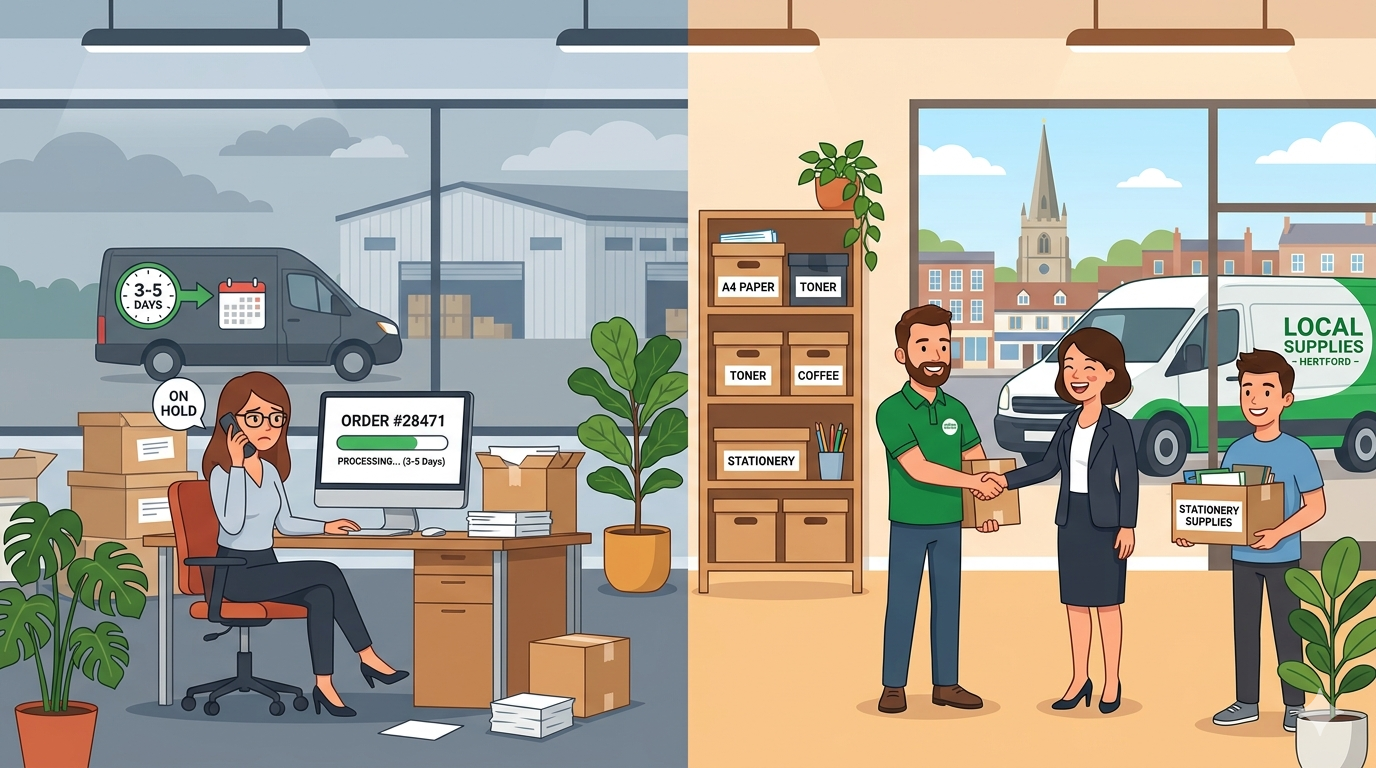
A practical guide, because where your supplies come from matters more than you think
When you need office supplies, what do you do? Jump online? Click a few buttons? Wait for a delivery from a warehouse somewhere far away?
It’s convenient. It’s familiar. And it might be costing you more than you realise, in money, time, and frustration.
Not because online suppliers are bad. But because a local partner offers things that algorithms and delivery vans simply cannot.
In this article, I’ll walk you through the surprising benefits of partnering with a local office supplies provider. Not just for big orders, but for the day-to-day relationship that keeps your office running smoothly. No jargon. No hard sell. Just honest, practical reasons to consider going local.
Let’s dive in.
Part One: The Hidden Costs of “Convenience”
Before we get into the benefits of local, let’s talk about what you might be missing.
What you lose with distant suppliers:
| Factor | The hidden cost |
| Delivery times | 2-5 days for standard delivery. Emergency? Pay extra. |
| No local stock | If it’s not in the warehouse, you wait. No alternatives. |
| No relationship | You’re an order number. No one knows your business. |
| No advice | Algorithms don’t understand your specific needs. |
| Returns and issues | Call centres. Email tickets. Long waits. |
| One-size-fits-all | Bulk discounts? Negotiation? Not for small accounts. |
These aren’t dealbreakers for every business. But they add up. And when something goes wrong, a damaged shipment, a wrong item, an urgent need, the distance hurts.
A local provider fixes most of these problems. Not because they’re magic. Because they’re close.
Part Two: The Benefits of Going Local
Let’s get specific about what a local partnership actually delivers.
Benefit 1: Speed That Actually Matters
What it means: You order today. It arrives tomorrow. Sometimes the same day.
Why it matters: When you run out of something critical, paper before a big proposal, toner on a busy Friday, waiting three days isn’t an option. A local provider can get it to you in hours.
Example: A professional services firm ran out of envelopes on a Thursday afternoon. Their online supplier could deliver in 3-5 days. Their local provider delivered the next morning.
The difference: No client delay. No emergency trip to a shop. No stress.
Benefit 2: Someone Who Knows Your Business
What it means: Your local provider knows what you order, how much, and when. They notice patterns. They make recommendations.
Why it matters: An algorithm might suggest “people who bought this also bought that.” But a real person notices that you’re going through toner faster than usual and asks if everything is okay. Or suggests a cheaper alternative when they see your volume increasing.
Example: A small business was buying expensive branded sticky notes. Their local provider suggested a functionally identical own-brand version at half the price. The business switched and saved £200 per year.
The difference: A partner who looks for ways to save you money, not just process your order.
Benefit 3: No Minimum Orders, No Hidden Fees
What it means: Local providers don’t need you to spend £50 for free delivery. They don’t charge extra for small orders.
Why it matters: When you just need one box of paper, you shouldn’t have to add £30 of things you don’t need to qualify for free shipping. A local provider delivers what you need, when you need it.
Example: A micro-business with two people needed toner occasionally. Their online supplier charged £6 delivery for orders under £30. Their local provider delivered for free because they were passing nearby anyway.
The difference: You buy what you need, not what you need to hit a threshold.
Benefit 4: Real Customer Service (Not a Call Centre)
What it means: When something goes wrong, you speak to a real person who knows your account. Not a script. Not a ticket number.
Why it matters: A damaged box of paper. The wrong toner arrived. An invoice discrepancy. With an online supplier, you’re in a queue. With a local provider, you call (or email) and get an answer. Today.
Example: A business received the wrong toner cartridge. Their online supplier required a returns authorisation, a shipping label, and a 10-day wait for the replacement. Their local provider swapped it on the same day.
The difference: Problems get solved in hours, not days.
Benefit 5: Flexibility and Negotiation
What it means: A local provider can work with you on pricing, payment terms, and delivery schedules.
Why it matters: Online prices are fixed. Algorithms don’t negotiate. A local provider values your business and can offer better terms, especially if you order regularly.
Example: A medium-sized business committed to a monthly order with a local provider. In return, they received a 15% discount across all supplies, free delivery, and 30-day payment terms.
The difference: A relationship that benefits both sides.
Benefit 6: Advice and Expertise
What it means: Your local provider understands office supplies. They can recommend alternatives, spot waste, and suggest improvements.
Why it matters: Are you using the right paper for your printer? Is there a cheaper toner option? Could you reduce waste with a simple change? These are questions an algorithm can’t answer.
Example: A business was constantly replacing printer rollers. Their local provider noticed they were using paper that was too heavy for their machine. Switching paper saved them hundreds in repairs.
The difference: A partner who helps you run your office better.
Benefit 7: Supporting the Local Economy
What it means: Your money stays in the local economy. Your provider employs local people. They pay UK taxes.
Why it matters: For many businesses, this is a genuine value. They want to support other local businesses, just as they want to be supported by their community.
Example: A family-owned business chose a local provider specifically because they wanted to “shop local.” It aligned with their brand values and resonated with their own customers.
The difference: A purchasing decision that reflects your values.
Part Three: What to Look for in a Local Provider
Not all local providers are created equal. Here’s what to look for.
Look For: Local Stock
What it means: They carry inventory locally. Not “we can order it in.” On the shelf, ready to go.
Why it matters: Local stock means local delivery. Today or tomorrow, not next week.
Ask: “What’s your typical delivery time for in-stock items?”
Look For: Knowledgeable Staff
What it means: The people answering the phone understand the products. They can advise on alternatives. They know what works with what.
Why it matters: When you have a question, you want an answer, not “I’ll have to check.”
Ask: “Can your staff advise on product compatibility and alternatives?”
Look For: Flexible Delivery
What it means: They deliver when you need it, not when their van is passing. They can do same-day for emergencies. They work around your schedule. You can choose to collect.
Why it matters: Your office has rhythms. A provider who understands that is valuable.
Ask: “What’s your emergency delivery policy? Is there an extra charge?”
Look For: Transparent Pricing
What it means: No hidden fees. No “surge pricing.” Clear invoices. Honest about discounts.
Why it matters: You should know what you’re paying and why.
Ask: “Can you provide a full price list? Are there any fees I should know about?”
Look For: Range of Products
What it means: They carry the supplies you actually need. Not everything, but enough that you can use them as your main provider.
Why it matters: You don’t want to manage five different suppliers. One local provider should cover most of your needs.
Ask: “Do you carry [your most common items]? Can you source items you don’t stock?”
Look For: Partnership Mindset
What it means: They see you as a partner, not a transaction. They look for ways to help you save money and run your office better.
Why it matters: A transactional relationship is fine. A partnership is better.
Ask: “How do you help your regular customers reduce costs or improve efficiency?”
Part Four: What to Expect from a Local Partnership
A local partnership isn’t magic. Here’s what reasonable expectations look like.
Reasonable expectations:
- Same or next-day delivery on in-stock items
- Friendly, knowledgeable staff who answer the phone
- Competitive pricing (not always the absolute cheapest, but fair)
- Flexibility on small orders and delivery schedules
- Helpful advice when you need it
Unreasonable expectations:
- Matching the absolute lowest online price on every single item (local have higher costs)
- 24/7 customer service (they’re local, not a global corporation)
- Every product under the sun (they focus on what their customers actually need)
The trade-off is simple: you trade absolute rock-bottom prices (maybe) for speed, service, and relationship. For most businesses, that’s a good trade.
Part Five: Examples
Here are a few examples of businesses that switched to a local provider, and why they stayed.
Example 1: The Emergency Toner
A small business ran out of toner on a Friday afternoon. Their online supplier couldn’t deliver until Tuesday. They had client proposals due Monday.
They called a local provider they’d never used before. The provider had the toner in stock and delivered it within two hours.
The result: The business switched their regular supply ordering to the local provider. They now get next-day delivery on everything, and they’ve never had an emergency since.
Example 2: The Wrong Paper
A professional services firm was buying expensive premium paper for all their printing. Their local provider noticed and asked why.
The firm explained they wanted client documents to look professional. The provider suggested using premium paper only for client-facing materials and standard paper for internal documents.
The result: The firm cut their paper costs by 40% with no change in client perception.
Example 3: The Delivery Headache
A busy office had constant problems with online deliveries. Packages left in the wrong place. Deliveries arriving when no one was there. Returned packages, re-orders, wasted time.
They switched to a local provider that delivered to their reception desk during office hours.
The result: No more missing packages. No more chasing deliveries. The office manager estimated she saved 30 minutes per week on delivery administration.
Example 4: The Relationship
A medium-sized business had been with the same online supplier for years. They had no complaints. But they also had no relationship.
They switched to a local provider as a trial. Within three months, the provider had suggested cost-saving alternatives, alerted them to a pricing error on an invoice, and delivered an emergency order on a Sunday.
The result: They never went back to the online supplier. “It’s not just about price,” the office manager said. “It’s about knowing someone has your back.”
Part Six: Making the Switch (Without Disruption)
Worried about switching? Here’s how to do it smoothly.
Step 1: Start Small
Don’t move all your ordering at once. Start with one category, paper, or toner, or cleaning supplies. See how it goes.
Step 2: Compare Pricing Honestly
Get a price list from the local provider. Compare it to what you’re currently paying. Be honest about differences. Sometimes local is cheaper. Sometimes it’s slightly more. Factor in delivery costs and convenience.
Step 3: Test Their Service
Place a few small orders. How fast do they arrive? How easy is the process? How helpful are they when you have a question?
Step 4: Communicate with Your Team
Tell your team about the new provider. Show them how to order. Get their feedback.
Step 5: Review After 3 Months
Is it working? Are you saving time? Is the service reliable? If yes, move more of your ordering. If not, have an honest conversation with the provider, or go back to your old way.
Part Seven: Is Local Right for Every Business?
Honestly? No.
Local is best when:
- You need supplies regularly (weekly or monthly)
- Running out would be a problem
- You value relationship and service over absolute lowest price
- You want to support local business
Online might still be better when:
- You order very rarely (once every few months)
- Price is your only consideration
- You need a huge range of specialist items
- You have no storage and need just-in-time delivery
For most small and medium businesses that use supplies regularly, local is a strong choice.
Final Thoughts
Your office supplies keep your business running. Paper, toner, envelopes, pens, these aren’t glamorous. But when you run out, you notice.
A local provider offers things that algorithms and distant warehouses cannot. Speed. Knowledge. Flexibility. Relationship. Someone who knows your business and has your back.
That doesn’t mean you should never order online. But it does mean that a local partnership deserves a place in your supply strategy.
Start small. Test a local provider with one category. See how it feels.
And if you’d like a friendly, no-pressure chat about local office supplies, whether that’s pricing, delivery, or just honest advice, just reach out.
We’re independent. We’re local. We’re here to help.