

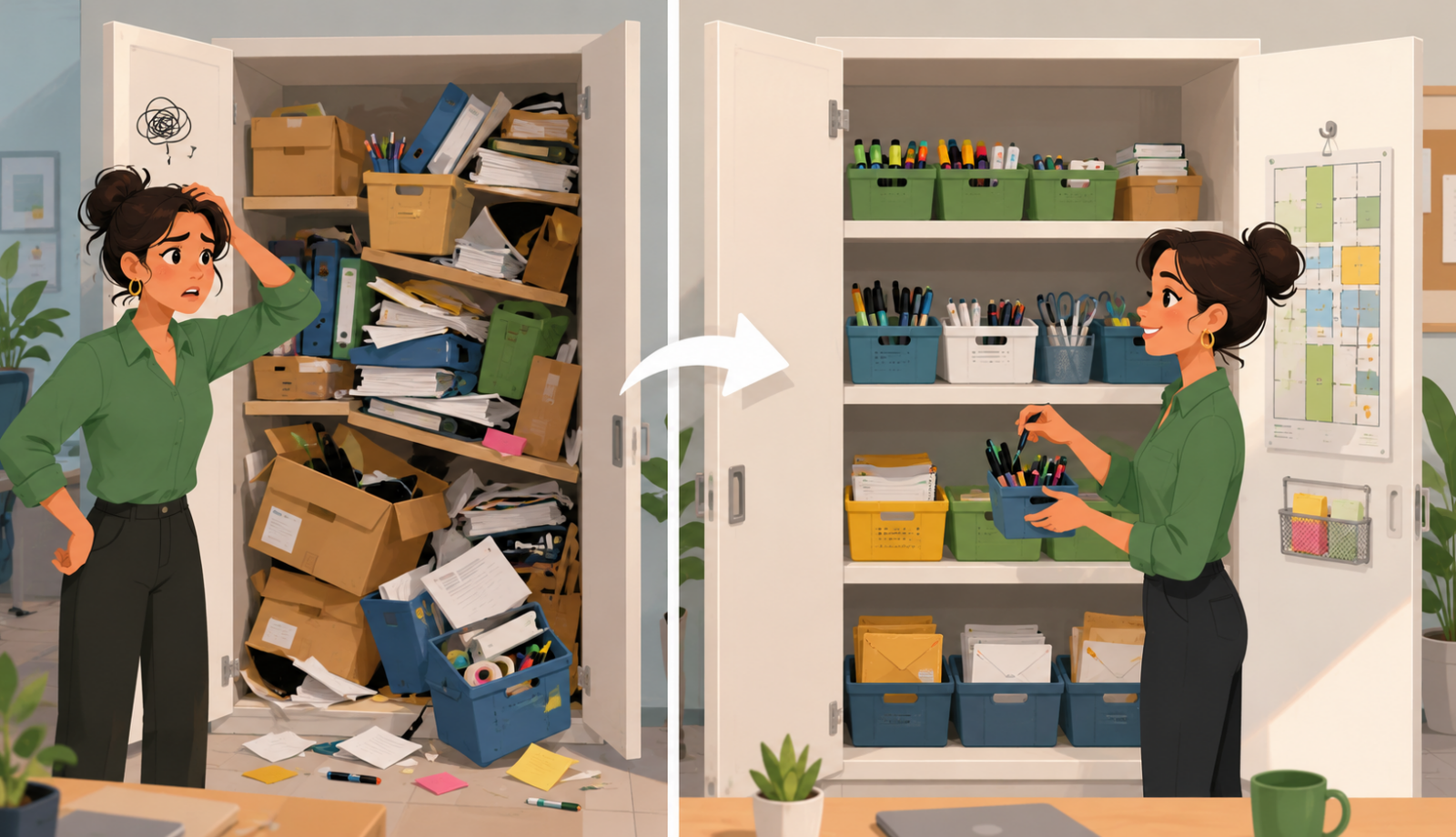
Think about the last time you needed a specific pen, a particular folder, or a spare notepad. How long did it take you to find it? Did you have to check three different cupboards? Ask two colleagues? Give up and use something else?
Now multiply that by everyone in your office. Every day. Every week. Every year.
That’s a lot of wasted time.
Office supply organisation doesn’t sound glamorous. But it’s one of those things that separates smooth-running offices from chaotic ones. When everything has a home, and everyone knows where that home is, your team spends less time hunting and more time working.
In this article, I’ll walk you through practical, proven ways to organise your office supplies for maximum efficiency. No expensive systems. No complicated rules. Just simple, actionable steps that make a real difference.
Let’s dive in.
Part One: Why Organisation Matters More Than You Think
Before we get into the how, let’s talk about the why.
The hidden costs of disorganisation:
- Time wasted searching: Studies suggest the average office worker spends 15–30 minutes per day looking for things, supplies, documents, equipment. That’s 1–2 weeks per year.
- Duplicate purchases: When no one knows what’s in the cupboard, people buy things you already have. You end up with five staplers and no hole punch.
- Expired or damaged supplies: Pens dry out. Sticky notes lose their stick. Toner sits so long it expires. All because supplies were lost in the chaos.
- Frustrated team members: There’s a reason “who took the last pack of Post-its?” is an office cliché. Disorganisation creates friction between colleagues.
- Wasted space: Cupboards full of things no one uses are cupboards you could be using for something else.
The benefits of good organisation:
- Faster work: Everything is where you expect it to be. No hunting, no delays.
- Lower costs: You buy only what you need, when you need it. No duplicates. No waste.
- Happier team: Small frustrations disappear. People can focus on their actual work.
- Better use of space: A tidy cupboard can hold twice as much as a chaotic one.
- Professional impression: When clients visit, an organised office looks competent.
The best part? Organising your supplies costs almost nothing. It’s mostly about systems and habits, not about buying expensive storage solutions.
Part Two: The Five Principles of Supply Organisation
Before we get into specific steps, let’s establish the principles that make any organisation system work.
Principle 1: Everything Has a Home
Every single item in your office should have a designated place where it lives. Not “somewhere in this cupboard.” Not “on someone’s desk.” A specific, labelled, known location.
Why it matters: When everything has a home, anyone can find it. And anyone can put it back. No more “who moved the labels?”
Principle 2: Like with Like
Store similar items together. All writing tools in one place. All paper products in another. All filing supplies together.
Why it matters: You don’t want to search three different cupboards for a highlighter. Grouping like items makes finding things intuitive.
Principle 3: Frequently Used Items Get Prime Real Estate
The things you use every day should be easiest to reach. The things you use once a month can live further away.
Why it matters: Your team shouldn’t have to climb on chairs or dig through boxes to get a pen.
Principle 4: Visual Clarity
You should be able to see, at a glance, what’s in a cupboard or drawer. No stacking boxes on top of boxes. No dark corners where things disappear.
Why it matters: When you can see what you have, you don’t buy duplicates. And you don’t waste time opening every cupboard to find something.
Principle 5: Maintainability
Your organisation system should be easy to maintain. If it requires a 30-minute tidy-up every day, it won’t last. Simple systems with clear rules are the ones that stick.
Why it matters: The best organisation system is the one that actually gets used.
Part Three: Step-by-Step Organisation Process
Ready to get organised? Here’s a simple process you can follow over a weekend or a few afternoons.
Step 1: Gather Everything in One Place
This is the scary step. But it’s essential.
Take every supply from every cupboard, drawer, desk, and shelf. Put it all on a large table or on the floor.
What to gather:
- Pens, pencils, markers, highlighters
- Paper (all sizes, colours, types)
- Notepads, sticky notes, index cards
- Envelopes (all sizes)
- Filing supplies (folders, dividers, tabs)
- Binders and binding supplies
- Toner and printer supplies
- Desk accessories (staplers, hole punches, tape dispensers)
- Cleaning supplies
- Anything else that lives in your supply cupboards
Pro tip: Wear gloves. Office cupboards get dusty.
Step 2: Sort and Purge
Now go through everything. Create three piles:
Keep: Items you actually use, in good condition.
Donate or give away: Items in good condition that you don’t need. (Local schools or charities often welcome office supplies.)
Recycle or throw away: Broken, expired, or unusable items. Dried-out pens. Empty toner cartridges. Sticky notes that no longer stick.
Be ruthless. If you haven’t used it in the last 12 months, you probably won’t. If it’s broken, don’t put it back “just in case.” If you have 20 black pens, you don’t need to keep all 20.
Step 3: Categorise
Now group your “keep” items into logical categories.
Common categories:
- Writing tools (pens, pencils, highlighters, markers)
- Paper products (printer paper, notepads, sticky notes)
- Envelopes and mailing supplies
- Filing and organisation (folders, dividers, binders)
- Desk accessories (staplers, tape, rulers, scissors)
- Printer and copier supplies (toner, paper, cleaning supplies)
- Cleaning and maintenance (wipes, sprays, cloths)
Pro tip: Watch how your team actually uses supplies. If everyone keeps sticky notes on their desk, don’t hide them in a cupboard. Put them somewhere accessible.
Step 4: Choose Storage Locations
Now decide where each category will live.
Frequency-based placement:
- Daily use: On desks or in open, reachable cupboards near workstations
- Weekly use: In easy-to-reach cupboards or drawers
- Monthly use: In higher or lower cupboards
- Rare use: In storage rooms, high shelves, or off-site
Pro tip: Keep supplies near where they’re used. Printer paper near the printer. Envelopes near the area where mail is processed. Filing supplies near the filing cabinets.
Step 5: Contain and Label
Now put your categories into containers. You don’t need to buy expensive systems. Cardboard boxes, clear plastic bins, drawer dividers, and mason jars all work fine.
What matters:
- Containers should be the right size, not so big that things get lost, not so small that you need ten of them
- Clear containers are best, you can see what’s inside without opening them
- Everything gets a label, “Pens,” “Sticky Notes,” “A4 Paper”
- Labels face forward, so you can read them without turning your head
Label ideas:
- Masking tape and a marker (cheap and easy)
- A label maker (more professional)
- Printed labels on cardstock (somewhere in between)
Step 6: Create a Map
Draw a simple diagram of your storage areas. Mark where each category lives. Stick it on the inside of the cupboard door.
Why it matters: When someone opens the cupboard and can’t find something, the map guides them. It also helps new team members learn the system quickly.
Step 7: Communicate and Train
Your organisation system only works if everyone knows how to use it.
What to communicate:
- Where each category lives
- The “everything has a home” principle
- How to request new supplies (don’t just shove things in cupboards)
- Who is responsible for maintaining each area
Pro tip: Have a 10-minute team meeting to introduce the new system. Show people where things are. Explain the rules. Answer questions.
Part Four: Specific Solutions for Common Problem Areas
Let’s look at some specific office areas and how to organise them.
The Shared Supply Cupboard
This is where organisation systems go to die. Here’s how to keep it tidy.
The solution:
- Use clear, labelled bins, one for each category
- Keep frequently used items at eye level
- Put a “return to home” sign inside the door
- Assign one person to do a weekly 5-minute tidy
- Have a “low stock” area where people put empty containers
Pro tip: Use a “first in, first out” system for items that expire (like toner or sticky notes). Put new stock behind old stock.
Individual Desks
Everyone’s desk is their own space. But some consistency helps.
The solution:
- Provide each desk with a small, standardised set of daily-use supplies (pens, sticky notes, scissors, stapler)
- Keep backup supplies in the central cupboard
- Encourage a “clear desk at the end of the day” policy (great for security and cleaning)
Pro tip: A small desk organiser (even a simple tray) makes a huge difference. It gives every item a home within the desk.
Printer and Copier Areas
This area gets messy fast. Paper everywhere. Toner boxes stacked. Old print jobs abandoned.
The solution:
- Keep printer paper in a dedicated cupboard or shelf right next to the printer
- Store toner in a labelled bin (not loose on a shelf)
- Put a small recycling bin nearby for misprints and old jobs
- Keep a “junk paper” tray for scrap paper (single-sided misprints)
Pro tip: A small set of drawers next to the printer can hold paper, toner, and cleaning supplies in one compact footprint.
The Stationery Order Point
This is where people go to request new supplies. If it’s chaotic, you’ll end up with duplicates and shortages.
The solution:
- Create a simple request form (even a clipboard with a printed sheet)
- Assign one person to check the request point daily
- Keep a master inventory list (even a spreadsheet) so you know what you have and what you need
- Order supplies weekly, not daily (less admin time)
Pro tip: Set minimum and maximum quantities. When paper drops below two reams, order more. Don’t wait until you run out.
Part Five: Maintaining the System
Organising is one thing. Staying organised is another.
Daily Habits (30 seconds)
- Put things back where they belong after using them
- If you notice something is low, add it to the request list
- If you open a new pack of something, put the old container in the “low stock” area
Weekly Habits (5-10 minutes)
- Tidy the supply cupboard (someone’s job, rotate weekly)
- Check the request point and update the master list
- Return any stray items to their homes
Monthly Habits (15-20 minutes)
- Do a full inventory (what’s low, what’s overstocked)
- Check for expired or damaged items
- Review usage patterns (are you ordering too much of something? too little?)
- Adjust the system based on what’s working and what isn’t
Quarterly Habits (30 minutes)
- Do a full purge (you’ll be surprised what accumulates)
- Revisit your categories, do they still make sense?
- Ask your team for feedback: “What would make the system better?”
Part Six: Example
Here are a few examples of offices that transformed their efficiency through better supply organisation.
Example 1: The Shared Cupboard Rescue
A small business had a supply cupboard that was a disaster. Boxes stacked on boxes. No one knew what was in there. People bought duplicates constantly.
They emptied the entire cupboard onto a conference table. They found seven staplers, twelve rolls of tape, three half-used packs of sticky notes, and a toner cartridge that had expired two years earlier.
They purged ruthlessly. They bought clear bins and labels. They created a simple map on the inside of the door. They assigned someone to do a weekly tidy.
The result: The office manager estimated the team saved 15 minutes per day, each, not hunting for supplies. For a 10-person office, that’s 2.5 hours per day, 12.5 hours per week. Duplicate purchases stopped entirely.
Example 2: The Printer Area
A professional services firm had a chaotic printer area. Paper was stored in a cupboard on the other side of the office. Toner was in a box on the floor. Misprints piled up on the printer itself.
They moved a small shelving unit next to the printer. Top shelf: printer paper. Middle shelf: toner and cleaning supplies. Bottom shelf: a tray for scrap paper. They added a small recycling bin for misprints.
The result: Paper was always nearby. Toner changes took seconds. The printer area stayed tidy. Staff no longer walked across the office mid-print job.
Example 3: The Request System
A medium-sized business had no system for ordering supplies. People would shout “we’re out of envelopes!” or leave sticky notes on random desks. Things got ordered late, or not at all, or in duplicate.
They created a simple request clipboard next to the supply cupboard. A printed sheet with columns: item, quantity, date, requested by. Someone checked it every morning and placed the weekly order.
The result: No more shouting. No more forgotten requests. No more emergency runs to the stationery shop. The office manager saved two hours per week on supply administration.
Part Seven: The One-Page Efficiency Checklist
Use this checklist to assess and improve your supply organisation.
Storage and Layout
- Does every item have a designated home?
- Are similar items stored together?
- Are frequently used items most accessible?
- Are containers clear and labelled?
- Is there a map inside the cupboard door?
Systems and Habits
- Is there a clear process for requesting new supplies?
- Is someone responsible for weekly tidying?
- Is there a “low stock” area or process?
- Are supplies ordered weekly (not daily, not monthly)?
- Is there a master inventory list (even a simple one)?
Team and Training
- Does everyone know where things belong?
- Have new team members been shown the system?
- Do you ask for feedback on what’s not working?
- Is there a “put it back” culture (not just one person tidying)?
Continuous Improvement
- Do you do a monthly inventory check?
- Do you do a quarterly purge?
- Do you adjust the system based on what you learn?
- Do you celebrate and acknowledge good organisation habits?
Final Thoughts
An organised supply cupboard won’t transform your business overnight. But it will save your team minutes every day. And minutes add up to hours. And hours add up to days. And days add up to real productivity.
More than that, an organised office feels calmer, more professional, and more competent. When everything has a home and everyone knows where that home is, small frustrations disappear. Your team can focus on their actual work, not on hunting for a highlighter.
Start with one cupboard. One drawer. One area. Empty it. Sort it. Purge it. Categorise it. Label it. Then move to the next.
Small steps, consistently applied, transform chaotic offices into smooth-running ones.
And if you’d like a friendly, no-pressure chat about office efficiency, whether that’s supply organisation, equipment setup, or just honest advice, just reach out.
We’re independent. We’re here to help. And we won’t sell you things you don’t need.