

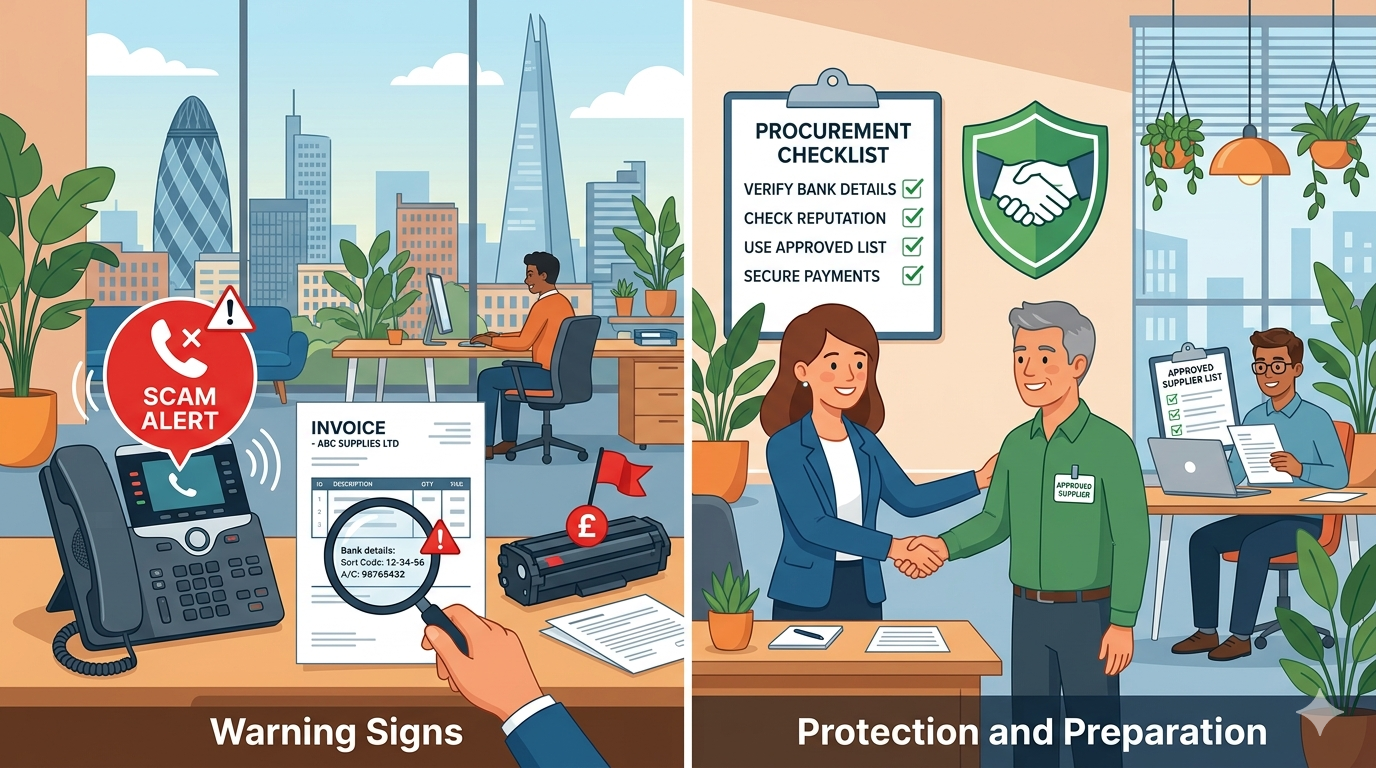
A practical guide: Because your budget shouldn’t fund fraudsters
Let’s be honest for a moment.
If you manage an office you’ve probably received that phone call.
“Hello, this is Sarah from your copier supplier. I’m just calling to confirm your toner order…”
The only problem? You don’t have a supplier named Sarah. You didn’t order any toner. And the price they’re quoting is three times what you normally pay.
Or maybe it’s an invoice that arrives by email. It looks legitimate — same layout, same logo, similar wording to your real supplier. But the bank details have changed. And if you pay it, your money disappears into a fraudster’s account.
Office supply scams are big business. According to Action Fraud, UK businesses lose millions every year to these schemes. And the scams are getting more sophisticated, not less.
The good news? Once you know what to look for, these scams are surprisingly easy to spot. In this article, I’ll walk you through the most common office supply scams, the warning signs to watch for, and simple steps to protect your business.
Let’s dive in.
Why Office Supply Scams Target Small and Medium Businesses
Before we get into the specific scams, let’s talk about why you’re a target.
Reason 1: You’re busy
Office managers and business owners are stretched thin. You don’t have time to investigate every phone call or invoice. Scammers rely on that.
Reason 2: You have regular suppliers
You order toner, paper, and other supplies on a regular basis. It’s easy for a scammer to pretend to be one of your existing suppliers.
Reason 3: Multiple people handle orders
In many offices, several people can authorise purchases. A scammer only needs to find one person who isn’t paying close attention.
Reason 4: You’re trusting
Small businesses often build good relationships with their suppliers. Scammers exploit that trust by pretending to be someone you know.
Reason 5: Low amounts, high volume
Many office supply scams involve relatively small amounts (£50–500). They’re not worth fighting over, and many businesses just pay and move on. But multiplied across thousands of businesses, scammers make fortunes.
Part One: The Most Common Office Supply Scams
Let’s start with the scams you’re most likely to encounter.
Scam 1: The Fake Toner Phone Call
This is the classic. And it’s still happening every single day.
How it works:
Someone calls your office, claiming to be from your regular copier or printer supplier. They say something like:
- “I’m just calling to confirm your next toner delivery…”
- “Your account shows you’re due for a refill…”
- “We have a special offer on toner this week…”
They sound professional. They might know your machine model (called before as a telemarketer). They might even know your name (LinkedIn is a goldmine for scammers).
If you agree, they send overpriced, low-quality toner — often compatible cartridges worth £20 that they charge £200 for. Or they send nothing at all and bill you anyway.
The hook: They create urgency. “Your toner is almost empty.” “This offer ends today.”
The target: Anyone who answers the phone and doesn’t check.
How to spot it:
- You don’t recognise the supplier name
- They can’t tell you your account number or last order date
- They’re vague about pricing
- They pressure you to decide immediately
- They ask for payment details over the phone
How to avoid it:
- Have a simple rule: “No orders over the phone unless I recognise the caller and expected the call.”
- Keep a list of your approved suppliers near the phone
- Never give payment details to an unexpected caller
Scam 2: The Fake Invoice
This scam is incredibly common and surprisingly effective.
How it works:
You receive an invoice by email or post. It looks legitimate — similar layout to your real suppliers, professional logo, correct VAT number (often stolen from a real company).
The invoice is for something you might actually order: toner, paper, printer maintenance, cleaning supplies. The amount is modest — £150–300 — small enough that you might pay it without thinking too hard.
But the bank details are fake. If you pay, your money goes to the scammer.
The hook: The invoice looks real, and the amount isn’t large enough to trigger suspicion.
The target: Anyone who processes invoices without verifying every single one against purchase orders.
How to spot it:
- You don’t have a purchase order or record of ordering the goods
- The supplier name is slightly wrong (e.g., “Office Depot” vs “OfficeDepot UK”)
- The bank details have changed from previous invoices
- The invoice number format doesn’t match previous ones
- You don’t recognise the goods or services
How to avoid it:
- Never pay an invoice without a matching purchase order or delivery note
- Verify any change of bank details by calling your supplier on a known number (not the number on the invoice)
- Set up two-person approval for payments over a certain amount
- Use accounting software that flags duplicate or unusual invoice numbers
Scam 3: The “Free Trial” That Isn’t Free
This one preys on busy offices who sign up for things without reading the small print.
How it works:
You receive a call or email offering a “free trial” of printer paper, toner, cleaning wipes, or some other office supply. All you have to do is agree to receive a sample.
What you didn’t read is the small print that says “free trial converts to paid subscription unless you cancel within 14 days.” The cancellation process is deliberately difficult — long hold times, only available by post, or hidden behind premium-rate phone numbers.
The hook: “Free” is a powerful word. And busy people don’t read terms and conditions.
The target: Anyone who says “yes” to a free sample without checking the terms.
How to spot it:
- The offer comes from a company you’ve never heard of
- They ask for payment details “just for verification”
- The terms and conditions are long and hard to find
- There’s no clear cancellation process explained upfront
How to avoid it:
- Never give payment details for a “free” trial
- If it’s genuinely free, they don’t need your credit card
- Search online for “[company name] scam” before agreeing to anything
Scam 4: The Directory Listing Scam
This one targets new businesses or recently moved offices.
How it works:
You receive an invoice or “renewal notice” for a directory listing you never signed up for. It might be a business directory, a health and safety compliance register, or a “data protection registration.”
The paperwork looks official — often designed to look like a government form. The amount is modest (£100–300). Many businesses pay it thinking they’ve accidentally signed up for something legitimate.
The hook: Official-looking paperwork and fear of non-compliance.
The target: New businesses, recently moved offices, or anyone who isn’t familiar with which registrations are actually required.
How to spot it:
- You’ve never heard of the organisation
- The registration isn’t required for your industry (check with your trade body)
- The “renewal” date doesn’t match anything in your records
- The small print says “this is not a government form” (scammers are required to include this, but it’s easy to miss)
How to avoid it:
- Know which registrations are actually required for your business
- Never pay an invoice for something you don’t recognise
- Search online for the organisation name + “scam”
Scam 5: The Overpayment Scam
This one is less common but very damaging when it works.
How it works:
A scammer “buys” something from you — maybe a large order of paper or toner. They send a cheque or make a payment that’s significantly more than the agreed amount. Then they contact you, apologise for the “mistake,” and ask you to refund the overpayment.
You refund the difference. Weeks later, the original payment bounces or is reversed. You’re out the amount you refunded, plus the goods you sent.
The hook: The urgency to “do the right thing” and refund the overpayment quickly.
The target: Businesses that accept cheques or payments from new customers without waiting for clearance.
How to spot it:
- The customer is new (you’ve never dealt with them before)
- The overpayment is significant
- They’re very insistent on getting the refund immediately
- They want the refund sent by a different method (e.g., bank transfer for a cheque payment)
How to avoid it:
- Never refund an overpayment until the original payment has fully cleared.
- If a customer overpays, return the full amount and ask them to send the correct amount
- Trust your instincts — if it feels wrong, it probably is
Scam 6: The Fake Engineer Call-Out
This scam targets your equipment rather than your supplies.
How it works:
Someone calls claiming to be from your copier or printer manufacturer. They say your machine has “flagged a critical error” remotely and needs immediate attention. They offer to send an engineer — for a fee, of course.
The engineer arrives (often in unbranded clothing), does something quick and superficial, and charges you £200–500. They might also “discover” additional problems that need expensive parts.
The hook: Fear of equipment failure and downtime.
The target: Anyone who doesn’t know whether their machine actually has remote monitoring.
How to spot it:
- Your machine doesn’t have remote monitoring (most small office copiers don’t)
- Your regular service provider hasn’t mentioned any issue
- The caller can’t tell you your contract or account details
- The engineer arrives without an appointment or branded vehicle
How to avoid it:
- Know whether your equipment has remote monitoring (ask your real supplier)
- Never agree to a service call from an unexpected caller
- Call your regular supplier on a known number to verify any reported issues
Part Two: The Warning Signs Cheat Sheet
Print this and keep it near your phone and invoice processing area.
Phone Call Red Flags
- The caller claims to be from a supplier you don’t recognise
- They can’t tell you your account number or last order date
- They’re vague about pricing or rush you to decide
- They ask for payment details over the phone
- They claim there’s an “urgent problem” with your equipment
- They offer a “free trial” that requires payment details
- The caller ID is unknown or looks suspicious
Invoice Red Flags
- You have no purchase order or record of ordering the goods
- The supplier name is slightly wrong or misspelled
- The bank details have changed from previous invoices
- The invoice number format doesn’t match previous ones
- You don’t recognise the goods or services billed
- The invoice is for a “directory listing” or “registration” you don’t remember
- The small print includes “this is not a government form” or similar disclaimer
Email Red Flags
- The sender’s email address is slightly wrong (e.g., @supp1ier.com instead of @supplier.com)
- The email contains spelling or grammar errors
- There’s a sense of urgency (“pay within 24 hours to avoid late fees”)
- The email asks you to click a link to “verify your account” (phishing)
- The attachment is unexpected or has a strange filename
Part Three: How to Protect Your Business
Now for the good stuff — practical steps you can take today.
Step 1: Create a Simple Purchasing Policy
You don’t need a 20-page document. Just a few clear rules.
Example policy for a small office:
- All orders must be approved by [named person or role]
- No orders accepted over the phone from unexpected callers
- Every invoice must match a purchase order or delivery note
- Any change of bank details must be verified by calling the supplier on a known number
- Never give payment details to an unexpected caller
Pro tip: Make sure everyone who can authorise purchases knows the policy. One person breaking the rules is all a scammer needs.
Step 2: Keep a List of Approved Suppliers
A simple spreadsheet or document with:
- Supplier name
- Contact number (the real one, not one from an invoice)
- Account number
- What you typically order from them
- Who approves orders
Keep this near the phone and with the person who processes invoices.
Step 3: Verify Before You Pay
For every invoice over a certain amount (even £50), ask:
- Do we have a purchase order for this?
- Did we receive the goods or services?
- Is the supplier on our approved list?
- Have the bank details changed? (If yes, verify by phone)
Pro tip: Set up two-person approval for payments over a threshold that makes sense for your business — £250, £500, or £1,000.
Step 4: Train Your Team
Scammers target the person who answers the phone, not the business owner. Make sure your whole team knows the warning signs.
What to cover in a 15-minute team meeting:
- The most common scams (phone, invoice, free trial)
- The warning signs cheat sheet (above)
- The simple rule: “If you didn’t expect the call, don’t agree to anything”
- Who to report suspicious calls or invoices to
Pro tip: Run a simple test. Have a friend call your office pretending to be a toner supplier. See who takes the bait. Then use it as a training moment (gently!).
Step 5: Use Accounting Software Safely
Good accounting software can help protect you.
Features to use:
- Purchase order matching (invoice won’t pay without matching PO)
- Duplicate invoice detection (flags if the same number appears twice)
- Approval workflows (two people must sign off)
- Bank feed reconciliation (see payments before they leave)
Pro tip: Never approve an invoice for payment directly from an email. Always log into your accounting software to review and approve.
Step 6: Know Your Real Suppliers
This sounds obvious, but it’s surprising how many businesses don’t have a clear relationship with their suppliers.
For your critical supplies (toner, paper, service):
- Have a named contact person
- Know their direct phone number
- Know what your contract includes
- Know what a typical invoice looks like
Pro tip: Call your real suppliers occasionally, just to stay in touch. A friendly relationship makes it much easier to spot when something is off.
Step 7: What to Do If You’ve Been Scammed
If you realise you’ve paid a fraudulent invoice or fallen for a scam, act quickly.
Immediate steps:
- Contact your bank immediately — they may be able to reverse the payment
- Report it to Action Fraud (actionfraud.police.uk or 0300 123 2040)
- If it involved a cheque, contact your bank to stop it
- Change any compromised passwords or payment details
- Alert your team so they don’t fall for the same scam
Don’t be embarrassed. These scams are sophisticated, and even very experienced office managers have been caught out. Reporting helps protect other businesses.
Part Four: Examples
Let me share some real examples (details changed, but the stories are true).
Example 1: The Toner Phone Call
A small law firm received a call from “Sarah” claiming to be from their copier supplier. Sarah knew their machine model and said their toner was critically low. The office manager, who was rushing to a meeting, agreed to a delivery.
The toner arrived — two basic compatible cartridges worth about £30 each. The invoice was £450. When they called their real supplier, they confirmed no such order had been placed.
What they learned: They now have a simple rule — no orders over the phone unless the caller is on their approved list and they expected the call.
Example 2: The Fake Invoice
An accountancy practice received an invoice for £280 for “printer maintenance.” It looked legitimate — similar format to their real supplier. The person processing invoices paid it without checking.
Three weeks later, they received a reminder for the same invoice. That’s when they realised they’d paid a scammer. Their real supplier had no record of the invoice or the maintenance visit.
What they learned: They now require a purchase order for every invoice over £50. No PO, no payment.
Example 3: The Directory Listing
A newly opened dental practice received an “invoice” for £195 for “health and safety compliance registration.” The paperwork looked official, with government-style branding. The practice manager, unsure what registrations were actually required, paid it.
Six months later, they received a “renewal” notice for the same amount. A quick check with their trade body confirmed that this registration was completely optional and provided no real benefit.
What they learned: They now know exactly which registrations are required for their industry. Everything else gets checked before payment.
Part Five: How a Good Supplier Protects You
This is where a trusted local supplier makes a real difference.
A good supplier will:
- Never cold-call you to sell toner (they know your usage patterns and will tell you when you actually need supplies)
- Never ask for payment details over the phone (they already have them on file)
- Never pressure you to make an immediate decision
- Be happy to verify any communication by phone or email
- Warn you about common scams targeting businesses like yours
Pro tip: Ask your real supplier if they’ve seen any new scams targeting their customers. Good suppliers track this and will share what they know.
Final Thoughts
Office supply scams are big business for fraudsters, but they don’t have to be a problem for you.
The key is awareness. Once you know what to look for — the unexpected phone call, the invoice without a purchase order, the “free trial” that requires payment details — these scams become easy to spot.
Put simple rules in place. Train your team. Verify before you pay. And build good relationships with trusted local suppliers who have your back.
Your budget will thank you. And you’ll sleep better knowing you’re not funding fraudsters.
And if you’d like no-pressure chat about office supplies, or if you’re ever unsure whether a call or invoice is legitimate — just reach out.
We’re local. We’re independent. And we’re here to help.