
The office of 2026 looks nothing like the office of 2019. The pandemic-era scramble to enable remote work has matured into a deliberate, strategic reimagining of what the workplace is for. Hybrid work is no longer an experiment; it is the default. And the technology shaping our offices has evolved in response.
Based on industry reports from IWG, Logitech, Microsoft analysts, and workplace technology experts, here are the top five office tech trends defining 2026.
- 🤖 AI at the Centre of Everyday Work
Artificial intelligence has moved from the experimental fringe to the absolute centre of daily operations. In 2026, AI is not a novelty—it is an invisible layer beneath almost every office task.
- The Rise of Agentic AI:
The big shift this year is from “generative” AI (tools that create content when asked) to “agentic” AI—autonomous agents that perform tasks independently on behalf of users . These agents don’t just wait for prompts; they anticipate needs, adjust to new information, and learn from experience.- Example: An AI agent might monitor your calendar, prepare briefing documents before meetings, draft follow-up emails, and update your CRM—all without being told.
- Copilot Everywhere:
Microsoft continues to embed Copilot across its entire stack. In Word, Excel, PowerPoint, Outlook, and Teams, AI now feels natural and embedded, helping users create content, analyse information, and manage workloads . The Business Central Wave 1 2026 update expands Copilot into deeper operational workflows, such as advanced sales forecasting and custom report generation via natural language commands . - The Governance Challenge:
With AI adoption comes complexity. As AI agents inherit delegated permissions, the risk of “permission sprawl” escalates . One misplaced sharing link can multiply risk exponentially. Forward-thinking organisations are implementing continuous, real-time monitoring of AI-driven permissions and automated remediation to stay in control.
Why It Matters: AI is no longer a “nice to have.” It is the productivity engine of the modern office. Businesses that fail to integrate AI into daily workflows will find themselves at a competitive disadvantage.
- 🏢 The Office as a Destination for Collaboration
The role of the physical office has fundamentally shifted. It is no longer a default place to work alone; it is a deliberate destination for specific activities that benefit from in-person interaction .
- Purpose-Built Spaces:
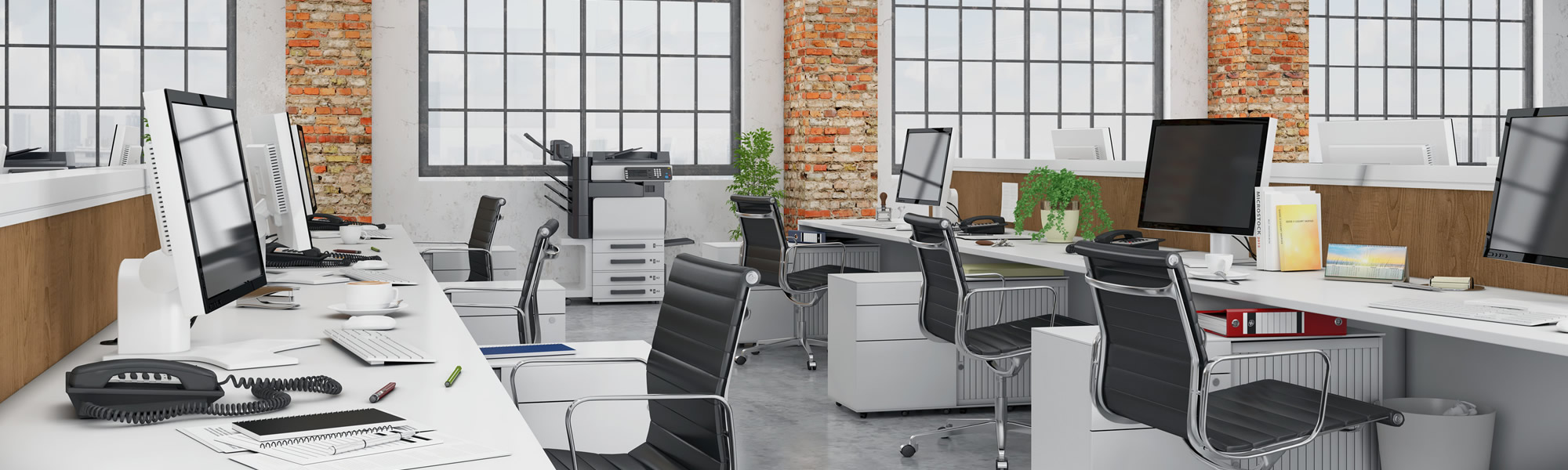
Companies are moving away from rows of desks toward spaces designed for workshops, creative sessions, and hands-on problem-solving. Think ideation studios, acoustic labs, and areas for rapid prototyping . - Multi-Location Flexibility:
IWG’s 2026 Global Office Trends Report highlights the shift from “return to office” to “multi-location work.” Employees now split time between headquarters, local flex spaces, and home . Microsoft, for example, requires many US employees to work at least three days a week from nearby offices, not necessarily headquarters . - Tech-Led Design:
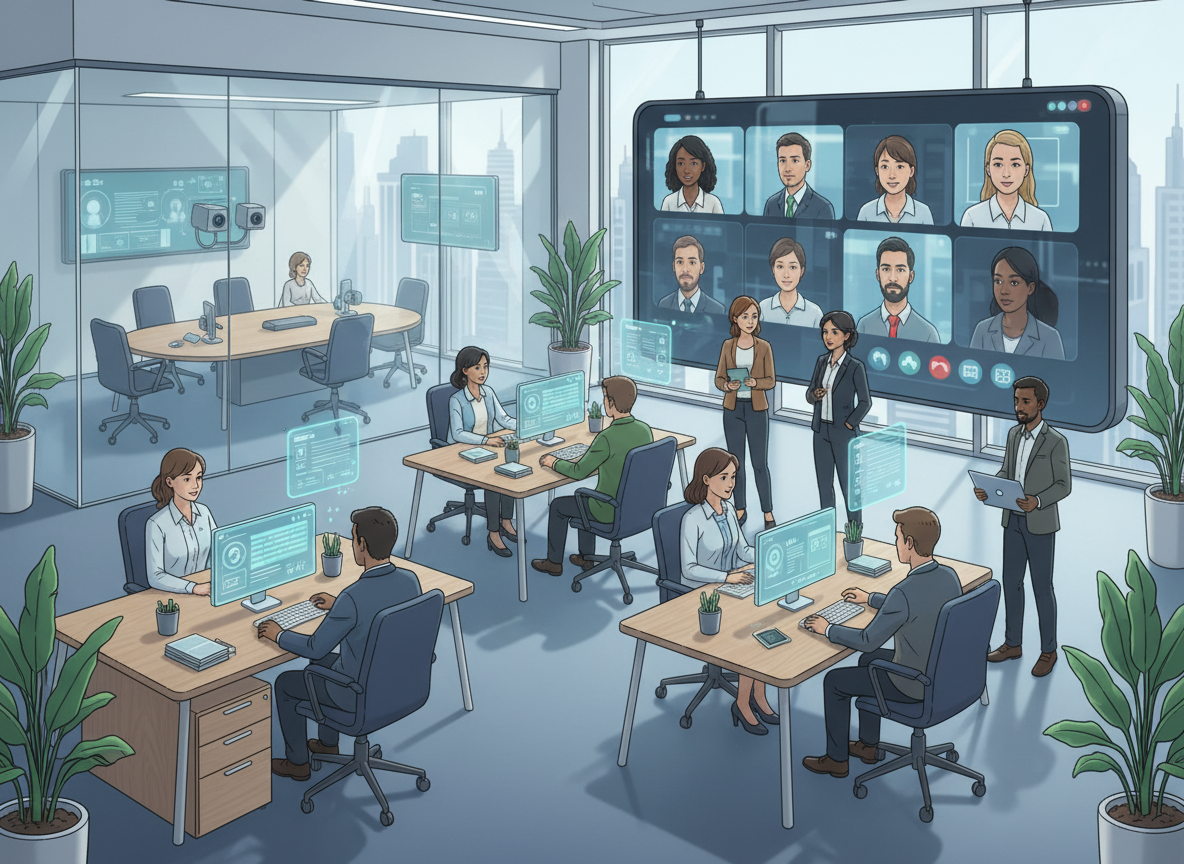
Technology is now a foundational element of workplace architecture—not an afterthought . Forward-thinking organisations design offices packed with technology to bridge hybrid teams while putting employee experience at the forefront.
Why It Matters: The office must earn the commute. If employees are coming in, the space and technology must deliver an experience demonstrably better than working from home.
- ⚖️ Meeting Equity Becomes Non-Negotiable
“Meeting equity”—the principle that every participant, whether in the room or joining remotely, can see, hear, and contribute equally—moved from pilot projects in 2025 to large-scale implementation in 2026 .
- What Good Looks Like:
The technologies that improve meeting equity most effectively share three characteristics:- AI-driven framing: Cameras that automatically zoom and frame active speakers
- Voice isolation: Audio that strips out background noise and balances participants
- Meeting intelligence: Real-time transcription, summaries, and action items
- Hardware and Software as One:
The best results come when hardware and platform intelligence operate as a single ecosystem. Cisco’s Room Bar Pro, for example, embeds AI directly into the Webex platform, while Logitech’s Rally Bar focuses on platform flexibility, certifying across Microsoft Teams, Zoom, and Google Meet . - The Return-on-Commute Factor:
IDC research suggests that if employees travel into the office, the meeting experience must demonstrably outperform home setups . Poor hybrid meetings actively discourage office attendance.
Why It Matters: In a hybrid world, the meeting room is the new factory floor. If it doesn’t work, nothing works.
- 🔗 The Rise of Seamlessly Connected Ecosystems
In 2026, the baseline assumption is that most business technology is already modern and connected. The real question is no longer whether technology is digital, but how well it works together in practice .
- Flow Over Features:
Samsung’s 2026 trend report describes this as the “year of flow”—technology that connects people, devices, and content quietly in the background, without demanding constant attention . Employees can pick up their work anywhere, stay connected across different touchpoints, and rely on consistent performance. - Platform Interoperability:
After years of “feature wars” between rival platforms, a truce is taking hold. Competitors are opening their platforms to support the multi-platform environments in which customers operate . In 2026, expect greater integration between Microsoft Teams, Zoom, Google Meet, and third-party applications. - Enterprise Capability, SME Simplicity:
Smaller businesses now access enterprise-grade capability without enterprise-level complexity. Devices integrate out-of-the-box with Microsoft 365, Teams, and OneDrive, requiring no custom setup or specialist IT teams .
Why It Matters: Friction kills productivity. The businesses that succeed will not be those with the most technology, but those whose technology works best together.
- 🌱 Sustainability Drives Procurement and Design
Sustainability has moved from a corporate social responsibility talking point to a core procurement criterion. In 2026, green credentials influence every office tech decision.
- Sustainable Financing:
The office equipment financing market is seeing strong growth in “green and sustainable” financing options . Lenders and lessors increasingly offer preferential terms for energy-efficient and sustainably manufactured equipment. - Eco-Friendly Supplies:
Even at the stationery level, sustainability dominates. Major manufacturers are introducing products like “plantable pens”—biodegradable pens with embedded seeds that can be planted after use . Ekopak’s EKOPEN, for example, features a removable seed at the base that users can plant once the ink is depleted. - Circular Economy Principles:
Businesses are prioritising suppliers who offer refurbished equipment, take-back schemes, and products designed for durability and repairability rather than planned obsolescence.
Why It Matters: Regulatory pressure, investor expectations, and employee preferences are converging. A credible sustainability strategy is now essential for talent retention and brand reputation.
Bonus Trend: Security and Resilience as Shared Responsibility
As AI complexity grows, so does the attack surface. In 2026, security is no longer an IT-only concern—it is an organisation-wide priority .
- Zero Trust Gets Real: Least-privilege access and continuous verification are now baseline requirements.
- Configuration Backup: Organisations are waking up to the reality that Microsoft does not automatically back up your tenant configurations. Third-party tools for configuration backup and disaster recovery are becoming essential .
- Employee Involvement: Asset reviews and permission checks are being democratised. Employees receive automated prompts to review shared files and remediate risks, guided by AI .
The Bottom Line
The office technology landscape of 2026 is defined by three forces: AI integration, hybrid intentionality, and seamless connectivity. The tools that succeed will be those that remove friction, earn their place in daily workflows, and adapt to how people actually work—not how we think they should work.
For business leaders, the challenge is no longer keeping up with technology. It is choosing the right technology and making it all work together.